






































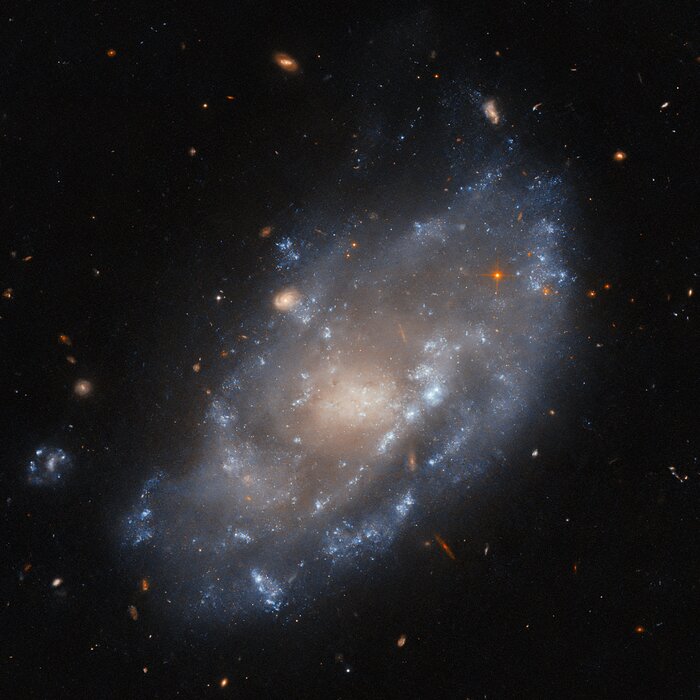
This NASA/ESA Hubble Space Telescope image features the dwarf galaxy IC 776. This swirling collection of new and old stars is located in the constellation Virgo, in the Virgo galaxy cluster, 100 million light-years from Earth.
Although IC 776 is a dwarf galaxy, it’s also classified as a SAB-type or ‘weakly barred’ spiral. This highly detailed Hubble view demonstrates that complexity. IC 776 has a ragged, disturbed disc that appears to spiral around the core with arcs of star-forming regions.
The image is from an observation program dedicated to the study of dwarf galaxies in the Virgo cluster that is searching for the visible light emissions from sources of X-rays in these galaxies. X-rays are often emitted by accretion discs, where material that is drawn into a compact object by gravity crashes together and forms a hot, glowing disc.
The compact object can be a white dwarf or neutron star in a binary pair that is stealing material from its companion star, or it can be the supermassive black hole at the heart of a galaxy devouring material around it. Dwarf galaxies like IC 776, traveling through the Virgo cluster, experience pressure from intergalactic gas that is similar to the pressure you feel from air hitting your face when you ride a bicycle. This intergalactic gas pressure can both stimulate star formation and feed the central black hole in a galaxy. As more material swirls down toward the black hole, it creates an energetic accretion disc, hot enough to emit X-rays.
While Hubble is not able to see X-rays, it can coordinate with X-ray telescopes such as NASA’s Chandra X-Ray Observatory, revealing the sources of this radiation in high resolution using visible light. Dwarf galaxies are very important to our understanding of cosmology and the evolution of galaxies. As with many areas of astronomy, the ability to examine these galaxies across the electromagnetic spectrum is critical to their study.
Text credit: European Space Agency (ESA)









Leave a comment